

Mayor and Town Hall Heritage
Contents
Town Hall heritage
The Town Hall and links to Colchester's civic past and present
- The Town Serjeant: The Town Serjeant is the ceremonial attendant to the Mayor. He carries the Great Mace on civic occasions.
- The Colchester Town Watch: The Town Watch provides the town with a ceremonial bodyguard for the Mayor for civil and social occasions.
- The Town Crier: The Town Crier makes public proclamations on civic occasions, as well as announcements within the City.
- Friends of the Moot Hall organ: The aim of the 'Friends of the Moot Hall Organ' is to bring back into use the Edwardian organ in the Moot Hall at Colchester's Town Hall.
- North Essex Heritage: Colchester has many fine buildings and memorials, with a varied and rich history.
- Castle, Hollytrees and Natural History Museum: Colchester offers lots to see for visitors and residents, with a historic past that comes to life with some exiting displays of history.
Guided tours of the Town Hall
The Town Hall continues to be called the ‘Town’ Hall, despite Colchester being granted City Status in 2022.
Group guided tours of the Town Hall, and it’s heritage can be arranged in advance free of charge. For further information and to enquire about dates for a tour, please click here.
The Town Hall is also open on Heritage Open Days.
Rooms within the town hall are also available for private hire for weddings, receptions and corporate hire.
The history of the city arms
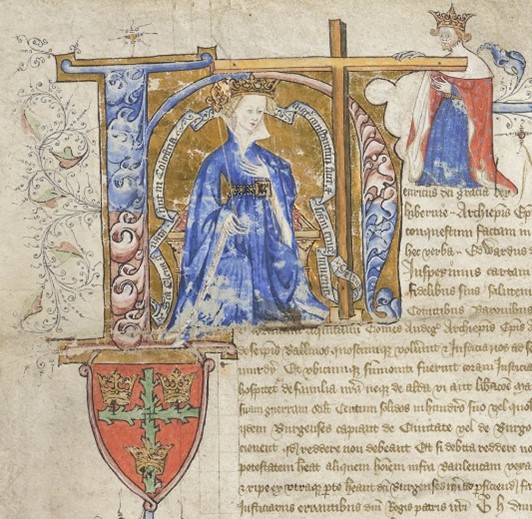
The earliest record of the city arms occurs in the royal charter granted to the borough of Colchester by King Henry V on 07 July 1413.
This charter, preserved in the city archives, has an initial letter decorated with a picture of St Helena holding the cross of Jesus Christ which, according to tradition, she found in Jerusalem.
Standing on the other side of the cross is St Helena’s son the Emperor Constantine who granted Christians freedom of worship in the Roman Empire. The legend that St Helena was born in Colchester goes back almost a thousand years.
The arms of Colchester which appear on the charter refer directly to the story of St Helena. The centre of the design is the True Cross, the actual cross on which Christ died, represented as a green living tree.
The cross has three iron nails which were used to fix Christ to his cross. The three crowns refer to the Three Kings of the Christmas story whose bones St Helena is also said to have found.
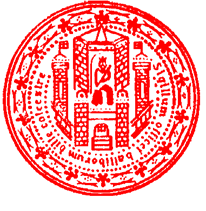
The Town Seal of Colchester, probably dated to 1413, also depicts Saint Helena with the cross.
The current city arms
These were granted by the College of Arms to (the former) Colchester Borough Council in 1976.
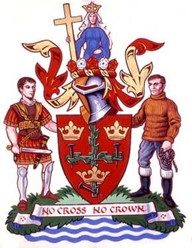
It was agreed by the borough council that the central shield of the new arms would be used for general purposes in future.
Colchester City Council are not in a position to give permission to other organisations or individuals to use the city arms, as this grant of arms was made solely to the council for its own use. However, organisations wishing to use the shield should seek permission from Colchester City Council (email mayorsoffice@colchester.gov.uk).
You may be interested to learn more about coats of arms and heraldry, why not try the Heraldry Society website or pay a visit to the Town Hall. How many borough arms can you spot in and around the building?
The city regalia, portraits and stained-glass windows
The city regalia
The Town Hall is home to some fine examples of silverware. Colchester’s mace was made in 1730 and is one of the largest in the country. It is a symbol of the council’s authority granted by the monarch and is used at many civic functions and council meetings.
Of special interest are a Victorian epergne, or table centrepiece, and a neff, or model ship, donated to the town in 1913 which can both be seen in the Mayor’s Parlour.
The oldest item of regalia is the bronze borough seal, which dates from about 1413. A replica forms the badge of office of the Mayor of Colchester.
Portraits and fine art
There are many portraits and paintings of famous Colcestrians in the ornately decorated rooms of the Town Hall, the portrait of the Queen Elizabeth II, by artist Richard Stone has pride of place in the Moot Hall.
One of the most important paintings in the borough's collection is 'A Flemish Merrymaking' by David Vinckeboons, which is on permanent display in the Grand Jury Room.
Stained glass windows
Within the Town Hall are some stunning stained-glass windows, especially in the Council Chamber and the Moot Hall. These depict the Roman Emperor Claudius, St Helena, Colchester’s patron saint, and include the Weavers' Memorial window.
Page last reviewed: 19 December 2025